
IT Strategy & Supplier Management
Your Technology Buyer’s Agent. Your Advocate at the Table. No Cost to You.
Think of YMBS as your realtor for technology—we find the right fit, negotiate the deal, and steer you away from money pits. And like a lawyer in a tough case, we protect your interests, pressure-test claims, and hold suppliers accountable.
You get one point of contact while we coordinate, filter, and vet suppliers (and their third-party implementers/trainers). Suppliers only show up when it’s worth your time—demos, key trainings, and final approvals.
Commission-based, paid by suppliers. Zero cost to you. Independent, client-first advocacy is non-negotiable.

Let's Chat: Common Company Questions About YMBS Answered
General Questions About YMBS Cybersecurity Services for Small Businesses

This FAQ shows how Yellow Mountain Business Solutions (YMBS) helps small and midsize organizations cut cyber risk, which threats matter most in 2025, and simple steps leaders can take now. You’ll get clear direction on priorities, the controls that reduce business risk fastest, how to train staff for real threats, and how to think about budgets and vendor choices. The article maps YMBS’s advisory, assessment, and hands-on testing approach into an easy sequence—assess, prioritize, remediate, train, and test—so non-technical leaders can act with confidence. Each section pairs short definitions, practical mitigations, and next steps aligned with NIST and CISA guidance for SMBs. Read on for tactical checklists, service comparisons, and concrete actions you can take this quarter.
Who Is Yellow Mountain Business Solutions and What Does YMBS Offer?
Yellow Mountain Business Solutions (YMBS) is a consulting firm that helps business leaders turn technology and security needs into practical plans, board and leadership training, and clear communications—cybersecurity being a core focus. Our goal is to give small and midsize businesses hands-on protection, real-world testing, and straightforward strategic advice that reduce risk, harden systems, and avoid costly downtime. We use a vendor-neutral, assessment-first approach so technical findings become business priorities. That makes trade-offs clear and helps leadership sequence work before committing to larger projects.
YMBS builds value around two steady commitments:
- Part of Your Team: We work alongside your staff, acting as an ongoing partner rather than a one-off vendor.
- Custom, Not Cookie-Cutter: Every engagement is tailored to your context and scaled to your risk profile and budget.
Those commitments drive prioritized, practical security work that connects technical controls to business outcomes and prepares organizations for today’s threats.
What Is YMBS’s Approach to Cybersecurity for Small Businesses?
We focus on fast, targeted assessment, prioritized remediation, and measurable improvement—explained in plain language for business leaders. First we assess your environment with tech audits and vulnerability scans to surface high-impact gaps. Then we prioritize fixes by business impact and ease of exploitation so limited budgets buy the largest drop in risk first. After that we help implement changes—rolling out MFA, hardening backups, correcting critical misconfigurations—and validate results with retests and tabletop exercises. That assess → remediate → test rhythm delivers quick wins and a clear roadmap to stronger resilience.
By centering outcomes and communication, YMBS helps non-technical stakeholders know what to expect and when—reducing procurement delays and aligning technical work with business continuity goals.
Why Are Small Businesses Prime Targets for Cyber Threats?
Small businesses are attractive to attackers because they often hold valuable data but run on tighter security budgets and decentralized IT decisions; attackers exploit that gap for big returns. In 2025, automated attacks keep rising—ransomware-as-a-service, AI-enhanced phishing, and cloud account-takeover tools that scale quickly against weaker defenses. The consequences are real: stolen credentials or unpatched systems can cause downtime, lost customer trust, and expensive recovery. Common root causes for SMB incidents include unpatched software, weak or missing multi-factor authentication, and backups that haven’t been verified.
Seeing these root causes clearly points to where to spend and what to train for—and it highlights the top threats that need immediate attention.
What Are the Biggest Cybersecurity Threats Facing Small Businesses Today?

The 2025 threat picture for SMBs is dominated by socially engineered attacks, extortion malware, and automated account-takeover campaigns that use AI to increase success rates. These threats exploit human error, cloud misconfigurations, and the many third‑party integrations common to small businesses. Controls that focus on multi-factor authentication, reliable backups, and phishing-resistant defenses provide the biggest reductions in breach probability and downtime. Below we outline the top threats with short impact summaries and one-line mitigations for quick reference.
This section separates the risks into two focused areas: primary attack vectors and other important risks SMBs should monitor.
How Do Phishing, Ransomware, and AI-Powered Attacks Impact SMBs?
Phishing is still the most common way attackers gain initial access: tailored emails and AI-generated content trick employees into revealing credentials or opening malicious files. A successful phishing attack can lead to credential theft, fraudulent wire transfers, and lateral access to core systems. Mitigation is clear: enforce MFA, use strong email security, and run regular simulated phishing campaigns to lower click rates. Ransomware causes lengthy operational downtime and high recovery costs when backups are incomplete or not properly isolated; core defenses include immutable backups, network segmentation, and rehearsed recovery playbooks. AI-powered social engineering makes messages more convincing and can bypass older filters, so pair behavior-based detection with continuous staff training to reduce human risk.
Technology plus human-centered training—used together—form the baseline defenses that reduce breach frequency and impact the most.
What Other Cyber Threats Should Small Businesses Watch For?
Beyond the top three, SMBs should watch cloud account takeovers, supply-chain compromises, insider risks, insecure IoT devices, and credential-stuffing campaigns that exploit password reuse. Cloud misconfigurations can leak data or allow privilege escalation—mitigate with strong access controls, role-based permissions, and thorough logging with alerting. Supply‑chain attacks target third‑party software or services—validate vendor security and monitor for unusual behavior. IoT devices often lack updates and can be weak network links—segment IoT traffic and maintain an accurate device inventory. Maintain credential hygiene—unique passwords and MFA—to limit credential-stuffing and account-takeover risk.
Tracking these vectors supports a layered defense and clarifies which controls and services will protect your data and systems most effectively.
How Can YMBS Help Small Businesses Protect Their Data and Systems?
YMBS protects data and systems with a prioritized mix of technical controls, process changes, and validation testing. We emphasize multi-factor authentication, reliable and tested backups, encryption for sensitive data, timely patching, access control policies, and secure cloud configuration. Our operational sequence is simple: audit to find the biggest risks, remediate high‑priority findings, then verify success with retesting and tabletop exercises. This Audit → Fix → Train → Respond flow follows NIST and CISA guidance while staying accessible to business owners.
Below is a comparison table of common YMBS service categories, what they protect, what clients receive, and typical time-to-implement ranges for SMB settings.
| Service | Protects | What to Expect | Time to Implement |
|---|---|---|---|
| Tech Audit | Configuration errors and blind spots | Deliverable: prioritized findings and a remediation roadmap | 2–4 weeks |
| Vulnerability Assessment | Known software and network exposures | Deliverable: scan results, risk ratings, and a patching plan | 1–3 weeks |
| Data Protection Solutions | Data at rest and in transit | Deliverable: encryption guidance, backup verification, and configuration checks | 2–6 weeks |
| Access Controls & MFA | Account compromise and privilege abuse | Deliverable: MFA rollout plan and enforcement policy | 1–4 weeks |
This comparison shows how targeted services map to near-term protections: start with audits for visibility, then phase in implementations that turn visibility into durable risk reduction.
YMBS usually begins with a short list of high‑impact controls to produce quick wins:
- Enable multi-factor authentication for all privileged accounts and external access.
- Implement automated, versioned backups and test recoverability regularly.
- Enforce timely patching for critical systems and establish basic endpoint monitoring.
Those controls reduce the likelihood and impact of common SMB incidents and build a foundation for ongoing improvement and compliance readiness.
What Data Protection Solutions Does YMBS Provide?
We recommend a layered data protection strategy: encryption, strict access controls, secure cloud configuration, and regularly tested backups to ensure recoverability. Encryption protects sensitive data at rest and in transit; access policies limit who can view or change critical records. Backups only help if you can restore from them—YMBS emphasizes backup testing and segmented storage so ransomware can’t affect both production and backups. In cloud environments we focus on account hygiene, least‑privilege roles, and alerting to surface suspicious access quickly.
Combining these protections reduces exposure and shortens recovery timelines—and it naturally leads to ongoing audits and employee training to keep defenses effective.
How Do YMBS Tech Audits and Vulnerability Assessments Work?
Our audits begin with scoping to identify assets and priority business processes, followed by automated scans and targeted manual checks to find misconfigurations and exploitable vulnerabilities. We compile results into a prioritized findings report that rates issues by business impact and exploitability, and we deliver a remediation roadmap written in plain language for leadership. Typical deliverables include an executive summary, an IT action list, and recommended quick wins you can implement in weeks. After remediation we retest to validate fixes and update the risk profile.
This structured assessment process turns abstract recommendations into concrete tasks with measurable outcomes and timelines.
What Cybersecurity Training and Incident Response Support Does YMBS Offer?

YMBS provides training and incident response (IR) services to build readiness: baseline employee awareness sessions, role‑based technical training for IT and finance, and facilitated tabletop exercises that exercise plans and communications. Training addresses human risk with simulated phishing, microlearning refreshers, and measurable metrics (for example, phishing click rates). Incident response support includes plan creation, documented playbooks, role definitions, communication templates, and test schedules that rehearse containment and recovery steps.
Below is a comparison table of YMBS training and IR offerings, recommended cadence, typical duration, and expected outcomes for small business clients.
| Offering | Recommended Frequency | Typical Duration | Expected Outcome |
|---|---|---|---|
| Introductory Awareness Workshop | Annual baseline + microlearning | 60–90 minutes | Lower phishing click rates and baseline security awareness |
| Role-Based Technical Training | Quarterly or as roles change | 90–180 minutes | Improved admin practices and fewer misconfigurations |
| Tabletop Exercises | Biannual | Half-day to full-day | Clearer roles and faster decision-making during incidents |
This table helps leaders pick a mix of training and testing activities that fit their size and risk profile while producing measurable readiness improvements.
We treat training as an ongoing program: awareness workshops teach basic precautions, role‑based sessions harden critical functions, and tabletop exercises validate response plans and communications. For teams ready to formalize readiness, YMBS builds playbooks and runs exercises that surface gaps before a real incident. To get started, schedule a discovery call with YMBS to define a training cadence and test plan that fits your people and risk profile.
How Much Cybersecurity Training Should Small Business Employees Receive?
All employees should get baseline training at least annually, plus short microlearning refreshers and simulated phishing campaigns delivered quarterly to reinforce behavior and measure progress. Employees with elevated access—system administrators, finance staff, vendor managers—should receive deeper, role‑based sessions at least quarterly and hands‑on practice as needed. Trackable KPIs like phishing click rates, incident response times, and percentage of devices with current patches provide objective measures of training effectiveness. Over time, those metrics guide continuous improvement and justify further investment in defensive tools.
These cadences fit into a broader readiness program where improved human behavior reduces successful breaches and complements technical controls.
SECProject Framework: Planning and Implementing Cybersecurity for SMEs
Appropriate cybersecurity investment is a baseline requirement for businesses operating in a digital world. The SECProject framework outlines the technical and economic steps needed to plan, implement, and run a cost‑effective cybersecurity program for small and medium enterprises. Its stages help non‑technical organizations optimize security spending while reducing business risk.
What Is an Incident Response Plan and How Does YMBS Help Develop It?
An incident response (IR) plan is a documented, role‑based playbook that defines detection, containment, communication, and recovery steps for cyber incidents; it assigns responsibilities and escalation paths so teams aren’t guessing under pressure. YMBS helps clients build IR plans by identifying critical assets, defining stakeholder roles, creating communication templates, and writing step‑by‑step containment and recovery playbooks. We run tabletop exercises to validate the plan, simulate realistic scenarios, and update the playbook with lessons learned. Regular retesting—annually or after major changes—keeps the plan current.
A practiced IR plan shortens recovery time, reduces financial loss, and helps preserve customer trust when disruptions occur.
NIST Cybersecurity Framework for SMB Risk Management
The NIST Cybersecurity Framework provides a common language and flexible, structured approach to managing cybersecurity risk. It works for organizations of all sizes and helps SMBs identify, protect, detect, respond, and recover from threats—giving leaders a practical roadmap to prioritize security efforts and investments.
Do Small Businesses Need a Dedicated Cybersecurity Expert or Can YMBS Fill That Role?
Choosing between hiring an in‑house cybersecurity expert and partnering with an outside provider depends on your scale, complexity, and tolerance for ongoing staffing costs. Small businesses with limited or variable security needs often get better value from an outsourced partner that delivers broad expertise on a predictable schedule. YMBS acts as an extension of internal teams—offering advisory retainers, project engagements, and incident support—so you can access senior expertise without the overhead of a full‑time hire. That blended model gives flexibility and specialized skills you might not otherwise have in house.
Below are practical criteria and the pros and cons of each option to help leaders choose the right path.
How Does YMBS Integrate with Small Business Teams as a Cybersecurity Partner?
YMBS supports several engagement modes—advisory retainers for ongoing guidance, project work for audits and remediation, and incident support when needed—each aligned to leadership reporting needs. Typical collaboration includes regular status briefings, prioritized action lists for IT teams, and non‑technical executive summaries that translate technical risk into business terms. We fill skill gaps, provide project management for remediation tasks, and hand over documentation and playbooks so internal teams can run operations confidently. This integration reduces knowledge silos and speeds decision‑making during an incident.
These partnership options let businesses scale expertise up or down while keeping clear accountability and predictable outcomes.
What Are the Benefits of Outsourcing Cybersecurity to YMBS?
Outsourcing to a partner like YMBS gives clear benefits: access to broader technical expertise, lower total cost than hiring multiple specialists, faster remediation from focused resources, and the ability to scale services as your business grows. Outsourced partnerships also make ROI easier to show by prioritizing high‑impact actions and demonstrating measurable risk reduction. Third‑party testing and tabletop exercises increase preparedness without the fixed cost of full‑time staff. For many SMBs, this leads to faster time‑to‑security and better alignment between technical work and business priorities.
For example, prioritizing MFA, backups, and a short vulnerability remediation sprint typically closes the most common breach vectors within weeks—often offsetting assessment costs by preventing a single significant incident.
Hybrid Cybersecurity Framework for Small Businesses: NIST CSF, ISO 27001, and CEO Engagement
Small businesses face growing cyber threats but often lack the resources to build full in‑house programs. This hybrid framework blends NIST CSF, ISO 27001 practices, and CEO engagement to create a practical, structured approach for improving cybersecurity posture and resilience in smaller organizations.
How Much Should Small Businesses Budget for Cybersecurity Services with YMBS?
Budget depends on size, complexity, regulatory needs, and desired service level. Rather than fixed prices, YMBS uses a tailored model that sequences must‑have controls, quick wins, and a roadmap for ongoing work. Primary cost drivers are user and device counts, cloud and third‑party integrations, monitoring hours (on‑call/24/7 vs periodic reviews), and compliance obligations. Treat cybersecurity as phased investments—baseline, recommended, advanced—so leaders prioritize high‑impact, low‑cost controls first and defer larger initiatives into planned phases. This staged approach preserves flexibility and maximizes prevention ROI compared with remediation spend.
The table below maps common cost drivers to typical service outcomes so leaders can match investment to risk tolerance.
| Cost Driver | Impact on Cost | Service-Level Outcome |
|---|---|---|
| User and device count | Scales with monitoring and license costs | Baseline security with prioritized controls |
| Cloud complexity | Increases need for configuration and monitoring | Continuous hygiene and alerting for cloud accounts |
| Regulatory/compliance needs | Requires documentation and controls | Auditable controls and reporting |
| Desired response level | 24/7 monitoring vs periodic reviews | Faster detection and reduced dwell time |
This mapping clarifies how different budget choices translate into risk reduction and operational readiness.
What Factors Influence Cybersecurity Costs for Small Businesses?
Key cost drivers include infrastructure complexity, cloud and third‑party integrations, number of privileged users, and required service level (continuous monitoring versus periodic reviews). More integrations and vendors mean a larger attack surface and higher monitoring needs; regulatory requirements add documentation and control work that lengthen implementation time. Internal staff skills also matter: organizations with capable IT teams can handle more remediation in‑house and reduce external hours, while teams without those skills benefit more from managed services. Understanding these factors helps leaders estimate one‑time assessment costs and recurring service investments.
Identifying your specific cost drivers enables YMBS—or any partner—to design a phased plan that balances immediate risk reduction with longer‑term improvements.
How Does YMBS Customize Cybersecurity Solutions to Fit Different Budgets?
We customize by breaking projects into phases—baseline (quick wins), recommended (broader controls), and advanced (continuous monitoring and deep testing)—and by prioritizing actions that yield the largest drop in business risk first. We sequence low-cost, high‑impact tasks like MFA rollout and backup verification before resource‑heavy initiatives. YMBS frames trade‑offs and expected outcomes in business terms so leaders can choose the phase that fits budget and risk tolerance. Regular checkpoints and roadmap updates keep plans aligned with changing needs.
This modular, prioritized approach helps small businesses achieve meaningful security gains quickly while preserving options to scale up as budgets allow.
Frequently Asked Questions
What are the key components of a cybersecurity strategy for small businesses?
A practical cybersecurity strategy for small businesses includes a risk assessment, employee training, an incident response plan, and regular audits. Risk assessments show where you’re exposed; training reduces human risk; an incident response plan guides action during a breach; and audits keep controls current. Together, these elements create a defensible program that aligns security work with business priorities.
How can small businesses ensure their cybersecurity measures are effective?
Make effectiveness measurable: use continuous monitoring, run regular vulnerability scans, and perform periodic penetration tests. Monitoring provides real‑time visibility, vulnerability scans find technical weaknesses, and penetration tests simulate attacker behavior. Pair these checks with metrics—phishing click rates, patch coverage, mean time to detect—to track progress and adjust priorities.
What role does employee training play in cybersecurity?
Employee training is essential because people are often the weakest link. Regular sessions teach staff to spot phishing, use strong passwords, and follow security procedures. Simulated phishing and short microlearning modules keep lessons fresh and produce measurable improvement. A security-aware team meaningfully lowers your overall risk.
How often should small businesses update their cybersecurity policies?
Review and update cybersecurity policies at least annually, and immediately after major changes—new technologies, regulatory shifts, or a security incident. Regular updates keep policies relevant. Tie policy reviews to ongoing training so employees stay informed about best practices and new risks.
What are the benefits of having an incident response plan?
An incident response plan provides a practiced process for managing incidents: who does what, how you communicate, and how you recover. A tested plan reduces confusion, speeds response times, limits damage, and helps preserve customer trust. Regular testing keeps the plan effective as your environment changes.
How can small businesses assess their cybersecurity readiness?
Assess readiness using self‑assessments, third‑party audits, and vulnerability scans. Self‑reviews map current policies and controls against best practices. Third‑party audits give an objective view and identify blind spots. Vulnerability scans reveal technical weaknesses. Together, these methods provide a clear picture of posture and priority work.
Conclusion
Partnering with Yellow Mountain Business Solutions (YMBS) helps small businesses reduce cyber risk through clear, prioritized strategies and hands‑on support. By focusing on high‑impact controls and measurable improvements, organizations can strengthen resilience against evolving threats while meeting compliance needs. Taking pragmatic steps now protects data and preserves customer trust. Contact YMBS to discuss a customized plan and next steps for strengthening your security posture.

How We Work: Your Tech Buyer’s Agent & Advocate
Discovery & Fit — We learn your goals, stack, compliance, budget.
Shortlist from 450+ — Apples-to-apples options that truly fit.
Due Diligence — Security, pricing, SLA strength, integration clarity, reference checks (supplier + 3rd parties).
Demo & Training Orchestration — Tight agendas, success criteria, minimal time sink.
Contract & SLA Negotiation — Terms that protect you; no “gotchas.”
Performance Oversight — KPIs, escalation paths, executive accountability.
Strategy First. AI Where It Pays.
Roadmaps that serve revenue, margin, risk, and capacity—today and tomorrow.
When useful, we add AI the practical way
In-house automation (assistants, analytics, routing).
Enterprise-grade AI via vetted partners.
Clear adoption plans, measurable ROI, no science-project theater.
Results You Can Expect
20–40% reduction in wasted tech spend:
(consolidation + smarter contracts).
Fewer delays & overruns:
(we’ve been down this road).
Higher adoption & ROI:
(structured training, clear KPIs).
No direct cost for our services:
(commission-funded).
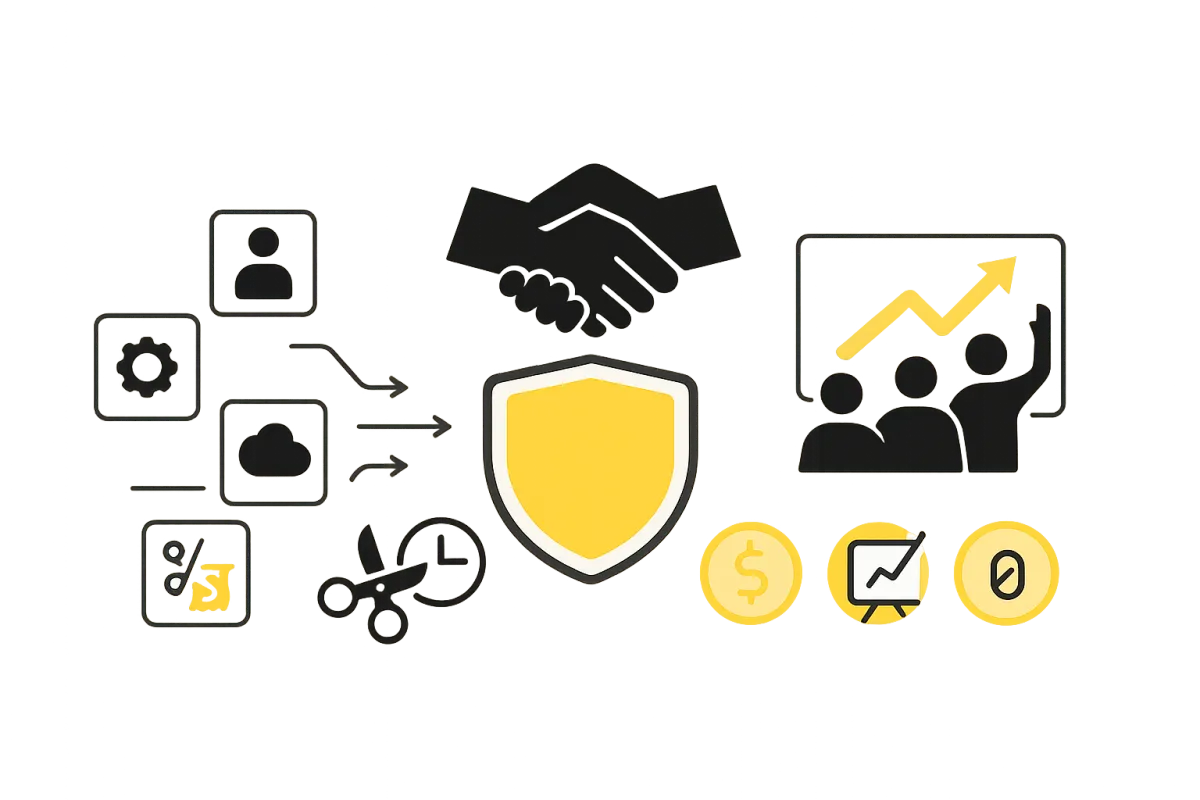
Ready for a buyer’s agent in your corner?
Get a strategist who learns your business, vets every player, and leverages
industry reputation to keep vendors honest—at no cost to you.
Are you like a technology realtor?
Yes. We act as your buyer’s agent—finding fit, negotiating value, and preventing expensive mistakes.
If suppliers pay you, are you really independent?
Yes. Our model is commission-based, but our standard is advocate-only: apples-to-apples options, documented trade-offs, and SLAs tied to your KPIs.
Do you vet third-party trainers/customizers?
Absolutely. We evaluate the vendor’s subcontractors with the same rigor as the primary vendor.
Why does your leverage matter?
Because we are a key account that suppliers rely on for repeat business, we carry influence that individual customers don’t. Vendors escalate faster, deliver better service, and avoid shortcuts because protecting their reputation with us is critical.

FOLLOW US


COMPANY
CUSTOMER CARE
LEGAL
Copyright 2026. Yellow Mountain Business Solutions. All Rights Reserved.